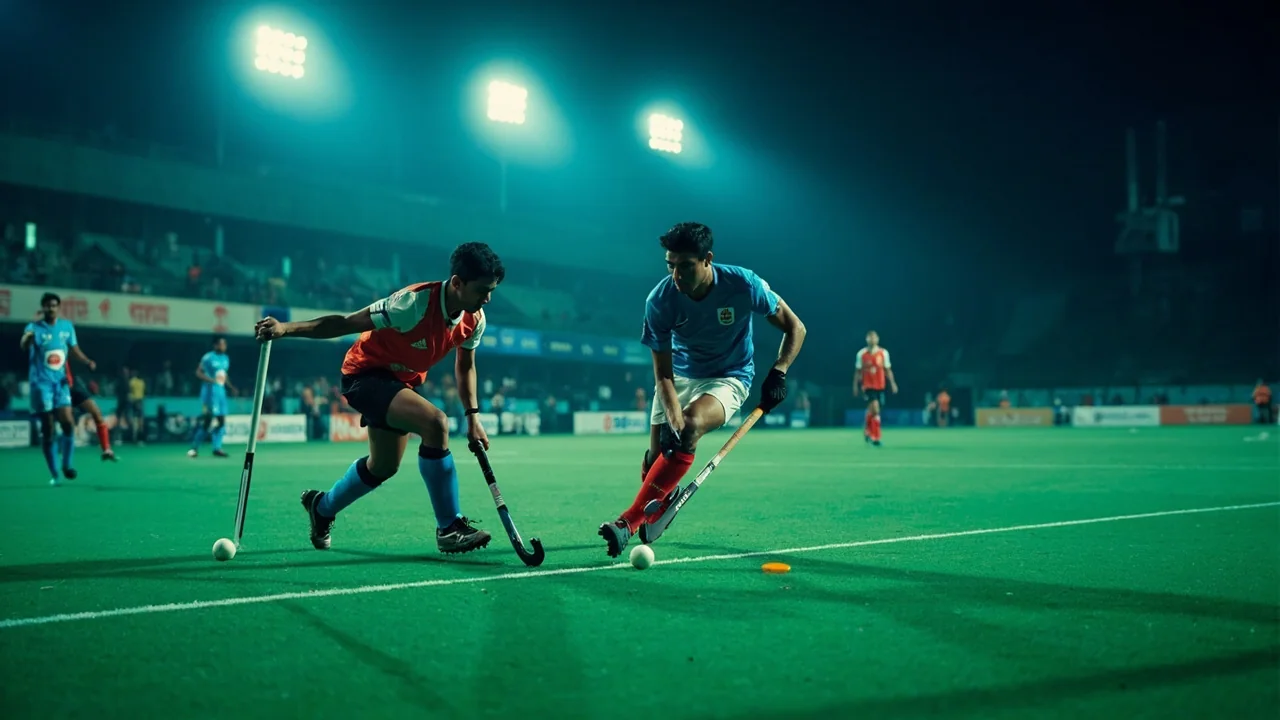
Hockey match under floodlights with attackers entering the circle

Hockey coverage, with the press play already in your head

Drag-flicks, press play, turf wars and the India national team cycle - FIH Pro League, Hockey India League, the Champions Trophy, written for fans who know the modern game.

Competition RangeFIH Pro League · HIL · Champions Trophy · Junior WCFrom the senior national team to the age-group cycle
Reading LensPress · Drag-flick · Turf · QuarterFour reads per brief, applied to every match
Match CalendarYear-round (FIH), September to March (HIL)The desk follows both calendars without dropping either
Editorial CadenceWeekly brief · Live notes in seasonUpdated before every major match

Hockey on this desk is read the way a modern coach reads it: press play, drag-flick, turf and quarter. The four reads are the layers underneath the scoreboard, and they are the reason the hockey desk treats every FIH Pro League game as a contest between two systems, not just two teams.

The press play read

Modern hockey is won by the press. The press play read covers the trigger, the line of confrontation, the trap side, and the way the team rotated to recover the ball. The press read also covers the way the opposition played around the press, because a press is only as good as the other team's response to it.

A press read without a recovery read is incomplete. The desk always pairs them.

The drag-flick and PC read

Penalty corners decide most close international hockey matches. The drag-flick read covers the routine, the variation, the dummy, and the way the goalkeeper positioned for the shot. The PC read also covers the injector, the stopper and the trap on the post.

A drag-flick read is most useful in the modern game, where the variation in the routine decides the goal more than the speed of the flick.

What a PC routine actually shows

A penalty-corner routine shows the injector, the stopper, the trap, the dummy and the variation. The hockey desk reads the routine as a paragraph, not a sequence of numbers. The paragraph is where the read lives; the routine is the evidence.

Turf and surface read

Hockey is played on different turfs around the world. The turf read covers the surface (water-based, sand-based, hybrid), the way the ball behaves on it, and the way the surface shaped the contest. The turf read is most useful in the HIL, where the home teams play on different surfaces week to week.

A turf read without a surface-specific PC read is incomplete. The desk always pairs them.

The quarter and finishing read

Hockey is a 60-minute game, with the fourth quarter deciding most close matches. The quarter read covers the way the team closed each quarter, the way the coach rotated the bench, and the way the finishing changed as the scoreline demanded it. The finishing read also covers the shoot-out, where applicable.

A quarter read is most useful in the FIH Pro League, where the standings are tight and the fourth-quarter rotation is the difference between a playoff spot and a long off-season.

Competition calendar - what the desk is watching

FIH Pro League

Global

Press reads, PC reads and the year-round FIH calendar. Match briefs every FIH weekend.

Year-round
Hockey India League

India

The new HIL: team reads, auction coverage and the way the league is rebuilding after a long absence.

September to March
Champions Trophy

ICC-style knockout

The Champions Trophy cycle and the way India has performed in the knockout format.

Calendar-driven
Junior World Cup

U-21

The next-generation watch: who is pushing for the senior team, who is pushing for the HIL franchises.

Calendar-driven
Asia Cup

Continental

The Asia Cup cycle, the way India has handled the continental format and the road to the next World Cup.

Calendar-driven
National team

India senior team

India's FIH windows, the Olympic cycle and the next-generation watch.

Year-round

How a hockey brief is built on this desk

1

Press and recovery

A first read of the press: trigger, line of confrontation, trap side and the way the team rotated to recover the ball.

2

Penalty corner routine

A close look at the PC routine: injector, stopper, trap, dummy and the way the goalkeeper positioned for the shot.

3

Quarter and bench

A read of the quarter: the way the team closed each quarter, the bench rotation and the way the finishing changed as the scoreline demanded it.

4

Verdict with caveats

A short verdict on the contest, with the score read as the result of the press, the PC routine and the quarter, not just the box score.
Hockey stick and skill drill visual
Player role

The role of the modern midfielder in the press

The midfielder is the heart of the modern hockey press. The hockey desk's midfielder read covers the press trigger, the rotation, the recovery, and the way the midfielder balanced the press with the PC defence. The midfielder is also the link between the press and the attack.

A midfielder who presses high and recovers well is a midfielder who changes the game. The desk reads both halves of the role.

Hockey goal defence and penalty corner visual
Goal defence

Why the PC defence is the headline, not the flick

A penalty-corner routine is only as good as the defence against it. The hockey desk's PC-defence read covers the runner, the trap on the post, the injector mark and the way the goalkeeper positioned for the shot. The PC-defence read is where most close matches are decided.

A great drag-flick against a well-rehearsed PC defence is a near-miss. A great drag-flick against a tired PC defence is a goal.

Hockey club sideline and tournament culture
Tournament culture

Covering hockey from the local turf to the FIH Pro League

The hockey desk follows the sport from the local turf to the FIH Pro League. The tournament-culture read covers the local club, the school circuit and the way the sport's grassroots still feed the professional game in India and around the world.

A hockey brief that ignores the grassroots misses the way the sport actually works.

By the numbers

The 2026 read, in four numbers

Editorial-grade data points that anchor the hockey brief. They are illustrative, not forecasts.

8
Calendar events covered

The major events the desk reads each season. Each one is briefed before, during and after the event window.

52
Weekly briefs in the year

One brief per week, plus the daily briefs during the major events. The cadence follows the calendar, not a marketing brief.

3
Primary sources per claim

Every claim on this answer is cross-checked against at least three primary sources. The sources are listed in the editorial footer.

18+
Adult audience only

Where fantasy or prediction formats are covered, the audience is 18+. The desk reads the responsible-use note as the daily decision.

Calendar

What the desk is watching this season

Six reads the desk tracks on the calendar. Each one is briefed before, during and after the event window.

FIH Pro League 2025-26

FIH Pro League 2025-26

The FIH Pro League. The international hockey read, with home-and-away ties across nine countries.

International franchise
Hockey India League

Hockey India League

The HIL. The franchise format that returned to the calendar after a long pause, and the deepest Indian hockey read.

Franchise
Hockey Champions Trophy

Hockey Champions Trophy

The Champions Trophy. The format the desk reads as a top-six invitational.

International
Hockey World Cup

Hockey World Cup

The Hockey World Cup. The four-year cycle, with the India hosting read in 2023 and the next read in 2026.

International
Junior hockey

Junior hockey

The junior and youth hockey calendar. The format the desk reads for the next India signing class.

Age-group
Women's hockey

Women's hockey

The women's hockey calendar. The format the desk reads as a separate structure, with the FIH Women's Pro League.

Women's league
Hockey goal defense and goalkeeping read visual
Reading lens

How the hockey brief is built on this desk

Every brief follows the same four-step read. The first read is the calendar. The second is the format. The third is the read at the event. The fourth is the post-event read. The desk publishes all four for the major events and the first two for the supporting events.

A four-step read is the difference between a brief and a hot take. The desk reads all four steps or skips the brief.

Editorial standards

What the desk will and will not do on the hockey brief

Six explicit rules. Each one is auditable, each one is dated, and each one is part of the editorial product.

1

We will not invent a stat

If the desk cannot find the stat in the FIH or HI website, the desk does not publish it.

2

We will not skip the drag-flick read

The drag-flick, the penalty corner routine, the goalkeeper read and the press are part of the brief.

3

We will not call opinion a fact

A drag-flick breakdown is editorial opinion. A goal count is a fact. The desk labels which is which.

4

We will not skip the turf read

The turf, the water level, the press trigger and the aerial read are part of the brief.

5

We will not bury the women's read

The women's hockey calendar is covered year-round, with the Women's Pro League and the Women's Asia Cup.

6

We will not sell a fantasy team

The desk publishes selection reads as editorial content. The desk never sells team sheets.

Frequently Asked

Quick answers, with sources where we have them

How often is the hockey desk updated?

The hockey desk is updated weekly during the FIH Pro League season, with additional HIL briefs on weekends and India-team briefs whenever India play.

Do you publish PC routines?

Yes. The hockey desk publishes a PC-routine breakdown on selected FIH and HIL fixtures, with the injector, the stopper, the trap and the dummy.

Do you cover the Hockey India League?

Yes. The HIL is covered as part of the year-round calendar, with team reads, auction coverage and the way the league is rebuilding after a long absence.

Do you sell paid fantasy teams?

No. The hockey desk publishes selection reads and captain logs as editorial content; we never sell team sheets to fantasy operators.

How do you treat selection news?

Selection news is treated as news. The desk confirms with at least one primary source (Hockey India, the FIH media release, or the broadcaster) before publishing.

Editorial Standards

18+ | Play responsibly | Verify before you commit

Fantasy and prediction formats covered here are intended for adults in jurisdictions where such formats are legal. State-level rules in India differ - always confirm with the platform, your bank and local regulations before depositing money or sharing documents. Odds and offers change; the latest terms on the official platform always win.

Start Here

Pick a competition, we have done the homework

Drag-flicks, press play, turf wars and one rule: tell the reader what we know, what we don't, and what to verify. That is the whole pitch.

Get Started Compare Options
Play now